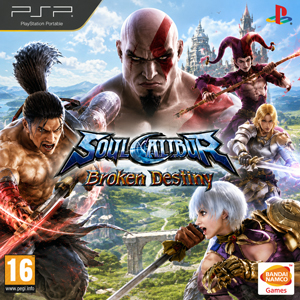
Soulcalibur – Broken Destiny Rom
| Console | Playstation Portable (PSP ISOs) > ROMs |
|---|---|
| Publish | 23 Jul 2026 |
| Emulator | PPSSPP – PSP Emulator |
| Genre | Action, Fighting |
| Region | USA |
| Size | 383 MB |
| Format | ISO |
| Downloads | 997 |
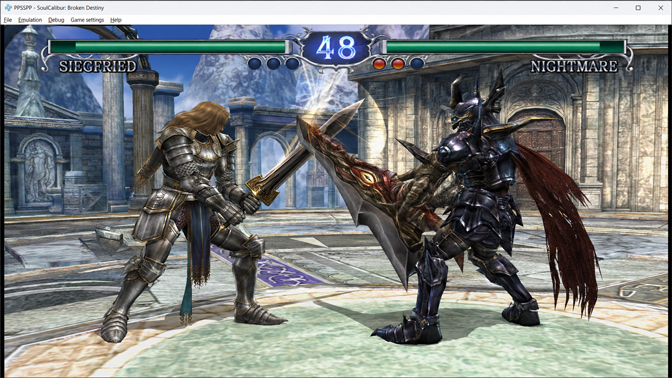
The SoulCalibur: Broken Destiny ROM is a PSP ISO for PPSSPP on Android or PC. Once the game is loaded, it feels less like a shrunken copy of Soulcalibur IV than a portable variation built around brief bouts and tightly defined challenges. There is no traditional Arcade ladder; some missions end after one correct block, a clean punish, or only a few seconds of survival.
If the download arrives as an archive, extract it first and load the .iso file inside. Do not unpack the ISO itself into separate folders. On Android, browse to its location from the Games screen. On a computer, open it through File > Load or add its folder to the game list. The game itself does not need to be installed inside PPSSPP.
Broken Destiny keeps Soulcalibur’s familiar input vocabulary: horizontal attack, vertical attack, kick, and guard. The fights are not simple, because opponents can circle each other and each weapon changes the range at which a reply is safe. Guard is not a permanent shelter either. Absorb too many attacks while blocking and the Soul Gauge weakens. Armor can break, and a Soul Crush can expose a fighter to a Critical Finish.
A win can still leave a weak score
Trials is where that difference matters. A cautious poke-and-retreat approach may still win Trial of Attack, but it leaves little on the scoreboard because the mode rewards pressure and consecutive hits. Defense flips the test by looking at what happens after a block, especially the counterattack. Endless removes the finish line: another opponent follows the last, successful hits push up the multiplier, and taking damage knocks it back down. The score can tell a very different story from the win screen.
For a more familiar duel, Quick Match is the nearest substitute for Arcade play. Its opponent screen imitates an online lobby, with custom fighters, names, records, and titles, but every match is against the CPU. Beat an entry and its displayed title becomes available. Player-versus-player fighting is separate: Versus uses the PSP’s local ad hoc connection between nearby systems, so there is no built-in internet matchmaking.
Kratos draws attention; Dampierre makes you hesitate
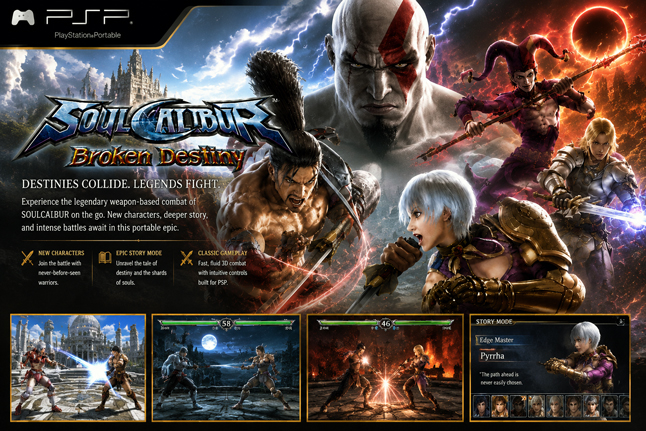
All 28 fighters are selectable from the start, which suits a game made for short sessions. The regular Soulcalibur IV roster returns, while that game’s Star Wars guests and bonus characters are absent. Kratos and Dampierre are the two additions, and neither feels like a name attached to a borrowed moveset.
Kratos uses chained blades that reach farther than his body position suggests. Backing away a single step does not always clear their arc, and the Icarus Wings give him an airborne option that stands apart from the weapon styles around him.
Dampierre works at close range, but distance is not his only trick. His spring-mounted daggers remain hidden beneath his wrists, and his feigned trips, collapses, and flashes of pain blur the moment when he is actually vulnerable. Chasing him because an animation looks like a mistake can put you exactly where his next strike needs you.
Character Creation drops the equipment math found in Soulcalibur IV. A custom fighter still borrows an existing character’s combat style, but clothing and weapons no longer modify performance statistics. Equipment is a visual choice here, so an outfit does not have to be compromised for a stronger build.
The Gauntlet gives you seconds to find the answer
At the start, the game warns that its comic story is not part of Soulcalibur canon. The plot mainly connects more than 80 short exercises, and many are not fights in the usual sense. You may enter with almost no health while an opponent is already attacking. The required response might be a throw escape, a stun recovery, a well-timed interruption, or a Guard Impact.
Failing is part of how the mode explains itself. The first hint may leave the timing unclear; after a miss, the dialogue becomes more specific and the same setup returns before the lesson has faded. Some exercises are solved in seconds, which keeps a troublesome input from turning into a long rematch.
Training is the calmer half of this design. You can read the move list and rehearse a command without the ambush, then go back to the scenario that exposed the gap. That rhythm is where Broken Destiny finds its portable identity. The game isolates one mistake at a time, then lets you retry while your hands still remember what went wrong.
.jpg)
 Rom](https://hexrom.com/images/icon/n/nocover.jpg)