Street Fighter II Turbo
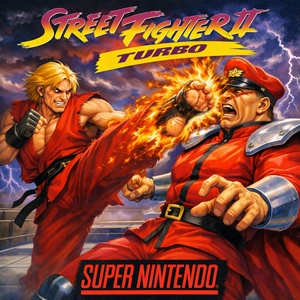
| Console | ROMs > SNES Super Nintendo |
|---|---|
| Publish | 25 Feb 2026 |
| Genre | Fighting |
| Region | Japan/USA/Europe |
| Size | 6.5 MB |
| Format | sfc |
| Downloads | 870 |
Street Fighter II Turbo on Super Nintendo has a punchier heartbeat than the earlier releases. The cast is familiar, the moves are familiar, yet the pace forces cleaner choices. A late anti-air, a predictable fireball, or a rushed jump does not just “hurt a little” here. It often decides the round.
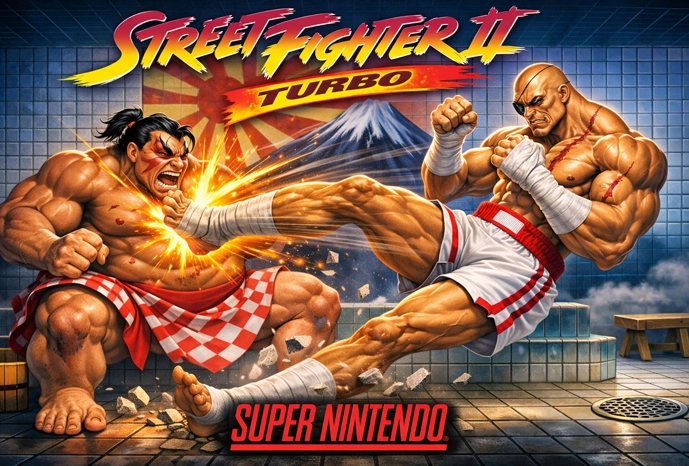
Turbo Pace That Shapes Every Round
Turbo speed does more than make the game feel faster. It changes how spacing and risk work. Footsies become more active because the window to correct a bad step is smaller. Fireballs still control space, but they work best when placed with intention, not tossed out on autopilot. The speed setting turns hesitation into a weakness, and it rewards players who can stay composed while everything moves quicker.
Match Tempo, Spacing, and Pressure
On SNES, Turbo keeps the match readable while raising the pressure. The best rounds are not about doing something fancy. They are about holding distance, checking jumps on time, and punishing obvious patterns. At higher speed, small advantages stack faster, so even “simple” decisions feel more valuable.
Character Notes That Matter at Turbo Speed
Street Fighter II Turbo does not rewrite the roster. It makes habits louder. Ryu and Ken feel strongest when fireballs are used to guide movement and you are ready to answer jumps without panic. Chun-Li becomes more dangerous when you control the space in front of you and turn brief openings into real damage. Guile can still lock down lanes, but the pace closes gaps quickly, so timing and patience matter more than ever. Across the cast, Turbo pace highlights fundamentals and punishes lazy repetition.
Using an .SFC Backup for Street Fighter II Turbo
The file for this entry is in .sfc format, a standard type for Super Nintendo game backups. Most SNES emulators open .sfc files directly with no extra steps. You may also see similar backups saved as .smc, and many emulators handle both formats in nearly the same way. For Street Fighter II Turbo, stable full-speed performance matters more than the extension name, because tiny delays are easy to feel in a fighting game.
Owning the original cartridge makes it straightforward to create a personal backup for your own use. That approach keeps the experience tied to a legitimate copy while letting you play on modern screens and controllers.
Emulator Choices That Respect Timing
Turbo is one of those SNES games where timing and controller response shape the entire experience. Snes9x is often the easiest way to get into a match quickly, and it usually feels responsive across a wide range of systems. bsnes is often chosen when accuracy and timing behavior are the top priority. RetroArch can work well too, especially for keeping controller profiles consistent, but the SNES core and latency settings are what determine how responsive the game feels.
Latency, Sync, and Audio Stability
Street Fighter II Turbo exposes input delay instantly. A move that feels “slightly late” on other games can feel unusable here at higher speed. Low-latency features can help, but gradual tweaks are safer than aggressive settings. Reducing latency step by step keeps the game stable and avoids stutter. Heavy visual effects can look nice, yet they can add delay. For a fighting game, responsiveness is usually the better trade. Audio stability matters because timing and rhythm are part of how Turbo feels. When audio drifts or crackles, the match can start to feel off even when the video looks fine.
Six-Button Mapping That Fits Turbo
The game feels more natural when punches and kicks sit on comfortable buttons. A practical six-button layout removes awkward combinations and makes specials more consistent. Reusing one saved controller profile keeps your button memory consistent, which matters a lot when you switch devices or change the Turbo speed setting.
When Turbo Feels Off: Slowdown, Input Lag, or Wrong Buttons
If the game suddenly runs in slow motion, the cause is almost always performance or video settings (sync, filters, or heavy effects), not the .sfc file. Input delay often improves with a wired controller, lower sync delay, and lighter video settings that keep the game steady. Wrong actions coming out are commonly caused by button mapping. Confirm the layout, save the profile, then test it in a versus round until it matches your hands.
Street Fighter II Turbo stays fun because it does not let sloppy play slide. When spacing is sharp, inputs are consistent, and reads are calm, Turbo speed turns every round into a tense, satisfying exchange that still feels great on SNES hardware and on a well-tuned SNES emulator.
![Street Fighter Collection DISC2OF2 Street Fighter Alpha 2 Gold [SLUS-00584] Rom](https://hexrom.com/images/icon/n/Street Fighter Collection DISC2OF2 Street Fighter Alpha 2 Gold [SLUS-00584].jpg)
.jpg)
![Ginormous Collection – Turbo Bike (19xx)(Alternative Software)(Side A)[aka Turbo Girl] Rom](https://hexrom.com/images/icon/n/Ginormous Collection - Turbo Bike (19xx)(Alternative Software)(Side A)[aka Turbo Girl].jpg)