Dig Dug Rom
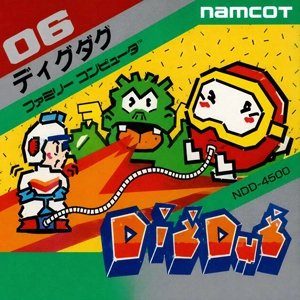
| Console | Nintendo (NES) > ROMs |
|---|---|
| Publish | 12 Jul 2026 |
| Genre | Action Arcade |
| Region | USA & Europe/japan |
| Size | 16 KB |
| Format | .NES |
| Downloads | 505 |
Dig Dug NES ROM turns an ordinary patch of dirt into a stage that gets more dangerous with every move. The controls are easy to learn. Dig a tunnel, keep away from the monsters, and use the air pump when one gets close enough. What takes longer to understand is that every path helps the enemies too. A tunnel made for escape can become the exact route that traps Dig Dug a few seconds later.
The NES adaptation keeps the arcade game’s central idea without surrounding it with extra systems. Each round begins underground with enemies already moving through the soil. There are no weapons to collect and no lengthy setup before the action starts. The goal is simply to clear the field, but doing that without creating a mess of unsafe tunnels is where the game becomes difficult.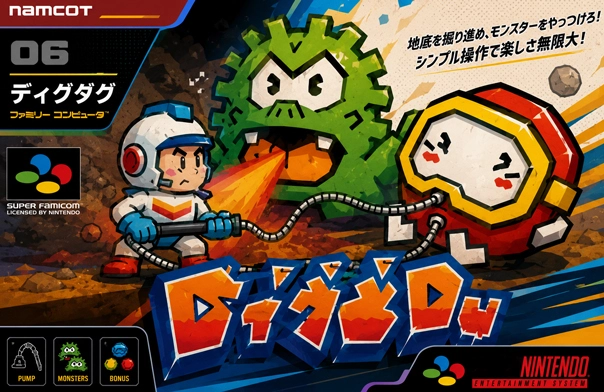
Every Tunnel Can Backfire
Pookas are the round red creatures with goggles. They are easy to recognize, but not always easy to keep in sight. Fygars are green dragons and bring a different problem to the stage. Their fire travels through horizontal tunnels, turning an open path into a hazard before Dig Dug has time to cross it.
Neither enemy is forced to remain inside the tunnels. When one loses sight of the player, it can fade into a pair of ghostly eyes and drift through solid dirt. It eventually returns to normal after reaching another open path, sometimes much closer than expected.
This makes standing still a poor option. A quiet corner may feel safe for a moment, then fill with enemies arriving through the surrounding soil. Digging away is not always the answer either. The new route may lead straight toward a Fygar waiting on the other side.
Dig Dug’s air pump works at close range. Once the hose connects, repeated button presses inflate the enemy until it bursts. There is enough delay in the attack for another creature to approach, so blindly finishing every target can end a good round quickly.
A partly inflated monster slowly recovers if the attack stops. During that brief period, Dig Dug can pass through it without taking a hit. Sometimes escaping is the better choice. The lost kill can be recovered later; a lost life cannot.
Rocks Change the Plan
Large rocks sit inside certain areas of the soil. Digging beneath one causes it to shake before it drops through the space below. That short warning is just enough time to move away, provided Dig Dug has not been boxed into the same tunnel.
A rock can crush more than one enemy, which makes it one of the best scoring opportunities in the game. Setting up that kind of hit is harder than it sounds. Monsters must be drawn toward the right place, and Dig Dug still needs an open route out before the rock falls.
Bad positioning turns the trap against the player. Dig Dug can be crushed by the same rock meant for the enemies, and an unexpected ghost movement can ruin the setup at the last second. That risk gives the rocks more purpose than a simple secondary attack.
After two rocks have dropped, a bonus item appears near the middle of the field. The early rewards are familiar fruits and vegetables, while later rounds offer items worth considerably more. They do not remain on screen for long.
Reaching the center often means crossing tunnels that have already become crowded. It is tempting to chase the item immediately, especially during a strong scoring run, but the safest route may disappear before Dig Dug gets there.
Score Chasing Changes the Game
Clearing the round is only one way to play. Digging through the soil adds small amounts to the score, while defeating enemies farther down the field can produce better rewards. Fygars are also worth more when attacked from the side, where their horizontal fire makes the approach more dangerous.
Rocks create the largest jumps in points when several monsters are caught beneath the same drop. Pulling that off usually requires leaving enemies alive longer than necessary. A careful player may spend part of the round shaping the tunnels and waiting for the creatures to gather instead of removing them at the first opportunity.
This is where Dig Dug starts to feel less like a basic action game. Playing safely and playing for a high score lead to different decisions. The air pump is dependable, but rocks offer a much bigger reward. Bonus items are valuable, but reaching one may place Dig Dug between two enemies with no easy turn available.
Short Rounds With Little Breathing Room
The NES graphics are simple, though the screen communicates danger clearly. Pookas and Fygars remain easy to tell apart, the tunnels stand out against the dirt, and a shaking rock gives a visible warning before it falls. Very little space is wasted.
Later rounds do not need complicated new rules to become harder. Enemies move faster, ghost movements are tougher to follow, and crowded tunnels leave less time to use the pump. Fygars also find more chances to attack from across the screen once the underground paths begin connecting.
The last remaining enemy may head for the surface and escape. That prevents the player from spending too long preparing a perfect attack after most of the field has been cleared. Hesitation can cost the final points.
A failed attempt is over quickly, which makes restarting easy. One more round often becomes several because the reason for losing is usually obvious: a tunnel was cut in the wrong place, an attack lasted too long, or a falling rock missed its target.
The Dig Dug ROM captures that compact NES style well. It begins with a small character, a few monsters, and a field of untouched soil. Within seconds, the same screen can become a tangled set of routes where every exit has a problem waiting nearby. Surviving comes down to understanding the paths Dig Dug creates and knowing when a risky move is actually worth it.
.jpg)
.jpg)
.jpg)